
In Part 1, I washed and carded fleece from a local merino sheep.
I was eager to start spinning!
I had clean wool. I had a drum carder. I had a drop spindle.
What more could a girl need?

The Step I Tried to Skip
When the wool came off the drum carder, it looked beautiful.
It was fluffy, clean, and soft. I was convinced I could sit down with my drop spindle and immediately start spinning yarn.
What I'd completely missed was the important step between carding and spinning: drafting.
Drafting is the process of gently pulling the fibers apart and aligning them so they can feed smoothly into the yarn as you spin.
I'd used a drop spindle before with pencil roving, in luscious wheels from Noro (now discontinued). That yarn had already been drafted, by machine.
Since I skipped that step entirely, my first attempt at spinning looked...
well...
The World's Lumpiest Yarn

This "yarn" was thick in some places, impossibly thin in others, and featured enough lumps to qualify as modern sculpture.
Never mind, I tied a lumpy bolo tie around my wooden giraffe Lenny and moved on.
Enter Drafting
Instead of feeding large chunks of fiber directly into the spindle, I learned to gently pull the carded wool into a thinner, more consistent preparation before spinning.
I experimented with how much air I could pull into the wool before the fibers separated. It started to make sense to me, that lots of daylight between the fibers would compress upon spinning into a finer yarn.
Ah, much better! This is the drop spindle experience I remember.
Although it still looked what could charitably be described as "rustic," I was definitely getting somewhere closer to yarn with a capital "Y".
My First Mini Skein

This little skein weighs only 17 grams.
It's far from perfect.
The thickness still varies.
There are places where I added too much twist and places where I didn't add enough.
But, I could start to imagine knitting with it.

As you can see, Sid the took his quality-control duties very seriously.
I submerged the little skein in hot water and a squirt of Unicorn Power Scour. A 15-20 minute bath finally removed all the lanolin from the yarn. I didn't mind its moisturizing properties while I spun, but I'll be interested to see how the next batch of raw wool turns out when I clean it properly from the outset.
From Mini Skein to Hat
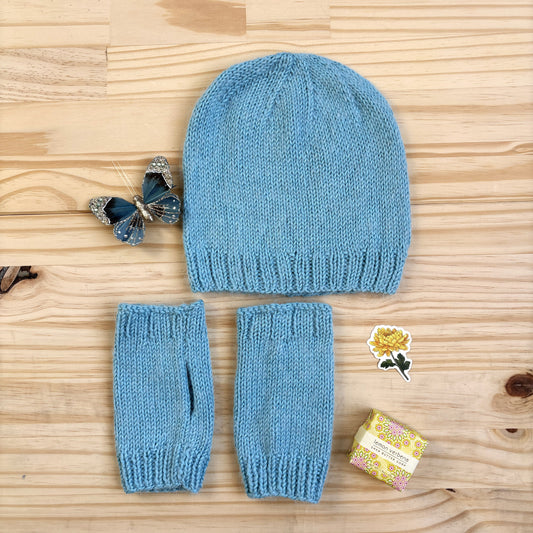
Once it was clean and dry, that first mini skein of handspun yarn was enough to knit a few stripes into a hat.

My dear friend Verna from Pinecones & Purls gave me the pumpkin-color Peace Fleece.
I decided on the hat pattern after searching "Handspun Hat" and finding inspiration from my friend Erin's new app, Knitwise by Feral Scene.
I cast on about 65 stitches (the worsted-weight Peace Fleece works up in a bulky weight very nicely) and joined in the round. A few rounds of ribbing, then a round of plain knitting before the stripes.
(My secret knitting-in-the-round hack: I wrap-and-turn and knit from the inside of the hat to make the reverse stockinette stripes. That way I'm always knitting instead of purling.)
See the Finished Hat
I've shared a short video showing the finished hat and the handspun stripes in action.
The journey from sheep to sweater isn't finished yet—but it's already taught me a tremendous amount about fiber, patience, and embracing imperfect first attempts.
And honestly?
I can't wait to spin the next skein.